What the Numbers on Your Work Gloves Mean?

Have you ever noticed a series of numbers and letters printed on the cuff of a pair of work gloves? These markings are more than product labels. They help explain how the gloves performed in specific safety tests and whether they may be suitable for particular workplace tasks.
For construction workers, industrial employees, contractors, and safety equipment buyers, understanding glove ratings can make product selection easier. Choosing gloves based only on their appearance or thickness may not provide the protection a job requires.
In this guide, we explain what the numbers on your work gloves mean, how to read EN 388 ratings, and what to consider when selecting leather safety gloves and other protective work gloves.
What Is the EN 388 Rating on Work Gloves?
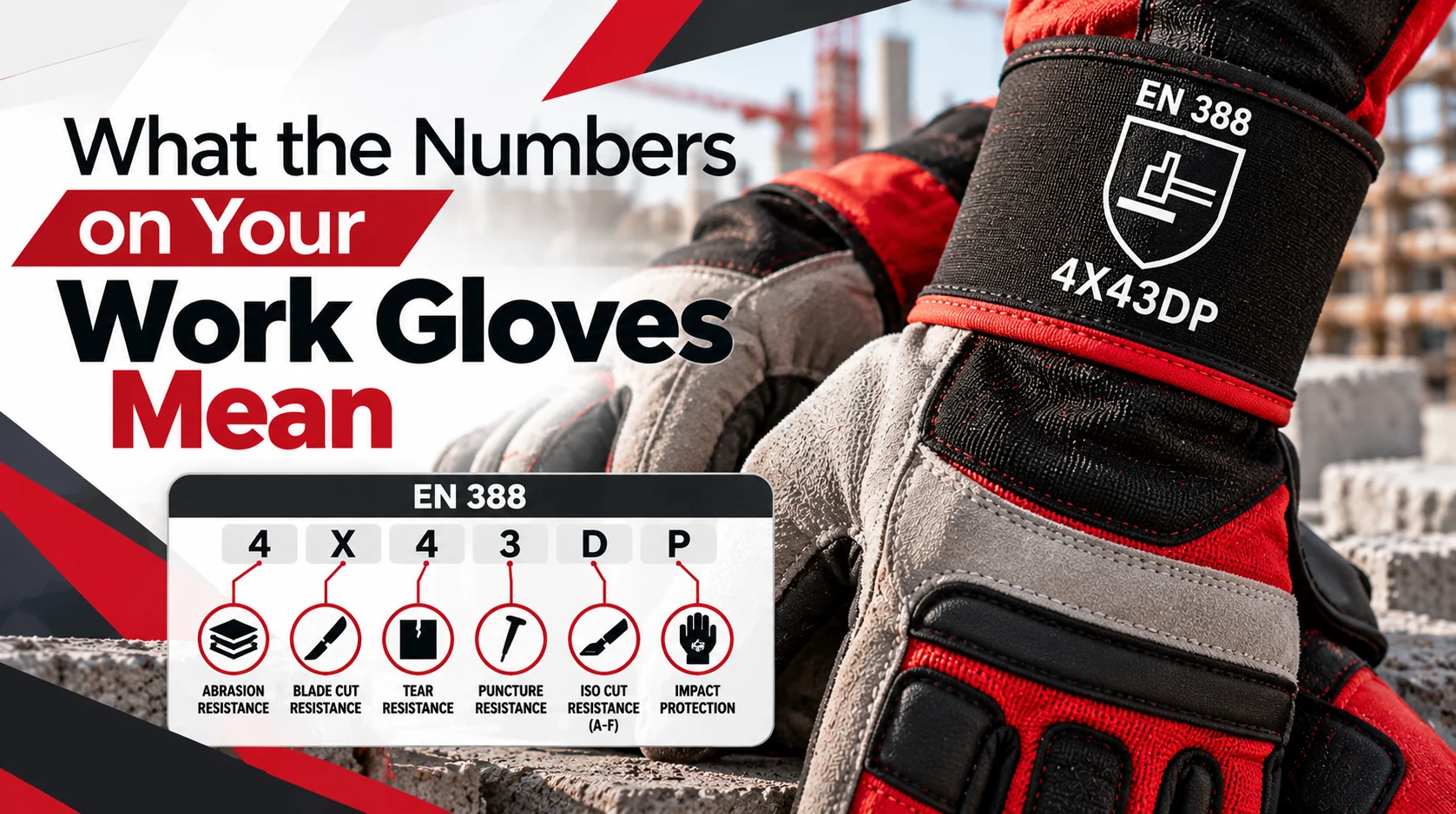
EN 388 is a European standard used to evaluate protective gloves against mechanical risks, including abrasion, blade cuts, tearing, and puncture. The current marking system can also include a separate cut-resistance result and an impact-protection marking.
You will usually find the EN 388 symbol on the glove label, packaging, or product documentation, followed by a combination of numbers and letters.
For example, a glove may display a marking such as 4X43DP.
Each character represents a different test result. Understanding the complete marking helps you compare gloves based on the hazards workers may encounter.
How to Read the Numbers on Your Work Gloves
Under EN 388, the characters appear in a specific order. The first four positions represent traditional mechanical-resistance tests, followed by a letter for the straight-blade cut test and an optional impact-protection result.
| Position | Test | What It Measures |
|---|---|---|
| First number | Abrasion resistance | Resistance to wear caused by rubbing |
| Second number | Blade cut resistance | Performance in the rotating-blade cut test |
| Third number | Tear resistance | Force required to continue tearing the material |
| Fourth number | Puncture resistance | Resistance to penetration by a specified test probe |
| Fifth character | ISO cut resistance | Straight-blade cut performance, graded A–F |
| Sixth character | Impact protection | A P indicates a pass in the applicable impact test |
The first four positions use numerical performance levels, while the fifth uses a letter when a result is reported. The sixth position may show P when the applicable impact test is passed.
Not every glove has six characters. The marking depends on the tests performed and the product’s classification.
1. Abrasion Resistance: How Well Do Gloves Resist Wear?
Abrasion resistance measures how well a glove material withstands rubbing against an abrasive surface under controlled testing conditions.
This rating is particularly relevant for workers who repeatedly handle rough materials, bricks, timber, metal components, and construction supplies.
Under EN 388, abrasion performance is classified into levels 1 to 4.
- Level 1: Basic abrasion resistance.
- Level 2: Greater abrasion resistance than Level 1.
- Level 3: Higher resistance for demanding wear conditions.
- Level 4: The highest abrasion performance level in this scale.
A higher abrasion level indicates better performance in the specified test. However, it does not guarantee a particular number of working days or months because actual glove life depends on the task, working conditions, material, and frequency of use.
For construction and material-handling applications, abrasion resistance is an important factor when comparing durable leather gloves and coated work gloves. Our guide on how to choose construction work gloves covers this in more detail.
2. Cut Resistance: Protection Against Sharp Edges
Cut resistance measures a glove’s ability to resist cutting under a specified test method.
This feature is important for workers handling sheet metal, steel components, sharp-edged materials, and other items that may cut the skin.
EN 388 includes two cut-test methods:
The Coupe Test
The second character represents the traditional rotating circular-blade test. Its performance levels range from 1 to 5, with higher levels indicating better performance in that test.
An X may appear when the test result cannot be classified or reported under the applicable marking rules.
The ISO 13997 Straight-Blade Test
The fifth character represents straight-blade cut resistance and uses levels A through F. Higher letters indicate greater cut resistance under this test.
This method is particularly useful for evaluating materials that can affect the performance of a rotating blade during the Coupe test.
Important: A cut-resistance rating should match the actual hazard. Workers handling sharp metal may require a different glove from those carrying timber or handling general construction materials.
3. Tear Resistance: How Well Can Gloves Withstand Tearing?
Tear resistance measures the force required to continue tearing a glove material after a tear has started.
This property matters when workers handle rough objects, heavy materials, or equipment that can catch and pull on the glove.
The EN 388 tear-resistance scale ranges from Level 1 to Level 4.
Higher levels indicate greater resistance under the specified test. However, tear resistance is not the same as cut resistance. A glove may resist tearing well but still be unsuitable for handling sharp blades or edges.
When comparing work gloves, consider tear resistance alongside the material, construction quality, and intended application.
4. Puncture Resistance: Protection Against Penetration
Puncture resistance measures how much force is required for a specified test probe to penetrate the glove material.
It is useful when evaluating gloves for tasks involving rough materials and certain penetration hazards.
EN 388 uses puncture-resistance levels from 1 to 4, with higher levels representing better performance in the specified test.
However, this test does not establish protection against every sharp object. For example, a standard puncture rating should not be assumed to prove protection against fine needles or every type of pointed object.
Always assess the specific hazard before selecting protective gloves.
5. What Do the Letters A to F Mean?
The letters A through F indicate the result of the EN ISO 13997 straight-blade cut-resistance test.
- Level A: Lower cut resistance within the A–F scale.
- Level B: Greater cut resistance than Level A.
- Level C: Greater cut resistance than Level B.
- Level D: Higher cut resistance for more demanding applications.
- Level E: Greater cut resistance than Level D.
- Level F: The highest level in this particular scale.
The scale is based on the force required to cut through the test specimen. For example, Level D corresponds to a force threshold of at least 15 newtons, while Level F corresponds to at least 30 newtons.
These are standardized laboratory classifications, not guarantees that a glove will prevent every cut in real working conditions.
When purchasing cut-resistant gloves, buyers should check the complete test marking and confirm that the selected level matches the workplace risk assessment.
6. What Does P Mean on Work Gloves?
The letter P in the final position indicates that the glove passed the applicable EN 388 impact-protection test.
Impact-protective gloves may be useful for tasks where the back of the hand is exposed to certain impact or pinch hazards, such as some equipment-handling and industrial applications.
If the P marking is absent, do not assume that the glove has certified impact protection under this test.
Also, impact protection does not automatically mean that a glove provides high cut, abrasion, or puncture resistance. Each property must be evaluated separately.
7. What Does X Mean in an EN 388 Rating?
The letter X is often misunderstood when reading glove markings.
An X does not automatically mean zero protection. It indicates that a performance level is not reported for that test position because the test was not performed, was not applicable, or the result could not be classified under the applicable method.
For example, in a marking such as 4X43D:
- The first character indicates abrasion performance.
- X appears in the Coupe cut-test position.
- The third character indicates tear performance.
- The fourth character indicates puncture performance.
- D represents the straight-blade cut-resistance level.
The complete marking and supporting product documentation should be checked before making a purchasing decision.
8. Example: Understanding a 4X43DP Glove Rating
Consider the following illustrative marking: 4X43DP
| Character | Meaning |
|---|---|
| 4 | Level 4 abrasion resistance |
| X | No classifiable Coupe-test result reported |
| 4 | Level 4 tear resistance |
| 3 | Level 3 puncture resistance |
| D | Level D straight-blade cut resistance |
| P | Passed the applicable impact-protection test |
This example shows why it is important to read the complete marking rather than focusing on one number.
A glove with strong abrasion resistance may still have a different level of puncture or cut resistance. The best choice depends on which hazards are present in the workplace.
This code is an example for explanation only, not a claimed rating for a specific Shakeel & Sons product.
9. Does a Higher Glove Rating Always Mean Better Protection?
A higher level generally indicates better performance in the specific test represented by that position. However, it does not mean that the glove is automatically better for every job.
For example, a glove with high cut resistance may not offer the best dexterity for precision assembly. Similarly, a highly abrasion-resistant glove may not provide the chemical or heat protection required for another task.
Before choosing gloves, consider:
- The main hazards workers face.
- The required cut, abrasion, tear, and puncture performance.
- Grip requirements for dry, wet, or oily surfaces.
- Comfort and flexibility during extended use.
- Correct sizing and secure fit.
- Other protection requirements that EN 388 does not cover.
EN 388 does not establish protection against every chemical, heat, electrical, or other workplace hazard. Additional standards and product-specific documentation may be required.
10. How to Choose the Right Safety Gloves for Your Business
For construction companies, industrial buyers, distributors, and wholesalers, understanding glove ratings is an important part of purchasing personal protective equipment.
Start by identifying the tasks workers perform and the hazards associated with those tasks. Then compare the relevant glove ratings and confirm that the product documentation supports the manufacturer’s claims.
Before ordering in bulk, consider the following:
- Material: Choose leather, coated fabric, or cut-resistant materials according to the application.
- Protection level: Check the relevant test results instead of relying on appearance.
- Fit and comfort: Ensure that workers can grip tools and perform tasks safely.
- Product quality: Review stitching, construction, and material consistency.
- Documentation: Request relevant test reports and conformity information where applicable.
- Supplier reliability: Evaluate product specifications, quality-control processes, sizing availability, and repeat-order consistency.
If you are comparing suppliers, our article on how to choose the right leather glove manufacturer explains what to check. Shakeel & Sons, based in Sialkot, Pakistan, is one of the leather glove manufacturers in Pakistan that manufactures and exports leather safety gloves and industrial safety products. Businesses looking for suitable hand-protection products can discuss their application requirements and review the specifications available for the relevant products.
Conclusion
The numbers and letters on your work gloves provide valuable information about their tested mechanical-protection performance. EN 388 markings help buyers compare abrasion, cut, tear, puncture, and applicable impact protection.
However, no single number tells the whole story. A glove must be selected according to the specific hazards, required protection levels, fit, comfort, and working conditions.
By learning how to read glove ratings and reviewing the relevant product documentation, construction companies, distributors, and industrial buyers can make more informed decisions when purchasing safety gloves.
Looking for leather safety gloves for your business? Explore the safety glove range from Shakeel & Sons and contact the company to discuss your product specifications and bulk purchasing requirements.